1. Guided By Voices - Big Boring Wedding
2. Sebadoh - Can't Give Up
3. The Fall - Pasts and Futures
4. Future of the Left - Johnny Borrell Afterlife
5. Magik Markers - Taste
6. The Dirtbombs - Sherlock Holmes
7. Sleigh Bells - Crush
8. The Raveonettes - That Great Love Sound
9. Jesus and Mary Chain - Happy When it Rains
10. Suede - Snowblind
11. The Ramones - Poison Heart
12. Imperial Teen - Runaway
13. Del Shannon - Runaway
14. Arcade Fire - Reflektor
15. Talk Talk - Life's What You Make It
16. Friends - Friend Crush
17. The Flatmates - Shimmer
18. The Housemartins - I Smell Winter
19. The Cure - Inbetween Days
20. Belle and Sebastian - Me and the Major
21. Lloyd Cole - Perfect Skin
22. The Fall - Totally Wired
23. Gang of Four - Natural's Not In It
24. XTC - Science Fiction
25. Richard Hell - Love Comes In Spurts
26. The Rezillos - 2000 AD
27. David Bowie - Cracked Actor
28. T Rex - Get It On
29. M83 - Midnight City
30. Sparks - Academy Award Performance
31. Chvrches - Lies
32. Depeche Mode - Enjoy the Silence
33. Yeah Yeah Yeahs - Heads Will Roll
34. OMD - Electricity
35. New Order - All the Way
36. The Cars - Magic
37. Prince - Sexuality
38. Public Image Ltd - Rise
39. The Stone Roses - Elephant Stone
40. Iggy Pop - I'm Bored
41. Faith No More - We Care a Lot
42. Idlewild - When I Argue I See Shapes
43. The Cramps - Garbage Man
44. Devo -
45. Yazoo - Situation
46. Prefab Sprout - King of Rock and Roll
47. The Smiths - Big Mouth Strikes Again
48. Pavement - Date with IKEA
49. Black Kids - I'm Not Going to Teach Your Boyfriend How to Dance With You
50. Beck - Loser
51. Wu Tang Clan - Gravel Pit
52. The Muffs - Kids in America
53. Weezer - Why Bother?
54. Franz Ferdinand - Darts of Pleasure
55. The Isley Brothers - Stop in the Name of Love
56. The Four Tops - Reach Out I'll Be There
57. Elvis - Hard Headed Woman
58. Haim - Don't Save Me
59. Fleetwood Mac - Little Lies
60. The Police - Roxanne
61. Britney Spears - Toxic
62. Janelle Monae - Tightrope
63. The Beatles - Taxman
64. Beastie Boys - Sabotage
65. Talking Heads - Girlfriend is Better
66. Madonna - Papa Don't Preach

Monday, 21 October 2013

Wednesday, 16 October 2013
review: Captain Phillips
Dramatising the real-life hijacking of an American freighter by Somali pirates, Captain Phillips
sees docudrama master Paul Greengrass occupying safe creative waters.
Of his previous work, there’s a particularly close resemblance (in both
style and structure) to 2006’s United 93 – another
moment-by-moment recreation of recent history that balanced macro
geopolitics with close-framed, claustrophobic terror.
But where the earlier film presented a fated collective, the title of Captain Phillips indicates a more conventional focus on a single, heroic individual – making the lead character’s casting as vital to the picture’s success as Billy Ray’s taut screenplay and the director’s kinetic flair. Thankfully, a bearded and Bostonian Tom Hanks has rarely been better, his everyman persona perfectly suited to the material and his escalating desperation reaching unbearable levels at the climax. Indeed, the closing scene’s visceral impact is so pronounced that the film’s less successful aspects (in particular, some unsubtle attempts at socioeconomic commentary) retreat from mind like backwash from a hull.
Out Fri 18th October
But where the earlier film presented a fated collective, the title of Captain Phillips indicates a more conventional focus on a single, heroic individual – making the lead character’s casting as vital to the picture’s success as Billy Ray’s taut screenplay and the director’s kinetic flair. Thankfully, a bearded and Bostonian Tom Hanks has rarely been better, his everyman persona perfectly suited to the material and his escalating desperation reaching unbearable levels at the climax. Indeed, the closing scene’s visceral impact is so pronounced that the film’s less successful aspects (in particular, some unsubtle attempts at socioeconomic commentary) retreat from mind like backwash from a hull.
Out Fri 18th October
Tuesday, 15 October 2013
October skinny
In Scotland, this is the cover yer after...

On this occasion, contributions from yours truly number 10:
- Field Music: An Interview with Jack Barnett of These New Puritans (read here!)
- David Byrne & St Vincent live review (read here!)
- Future of the Left - 'How to Stop Your Brain in an Accident' album review (read here!)
- The Grand Gestures - 'Second' album review (read here!)
- Your Loyal Subjects - 'Austerity Measures' album review (read here!)
- Young Aviators - 'Self Help' album review (read here!)
- Islet - 'Released by the Movement' album review (read here!)
- The Spook School - 'Dress Up' album review
- The Pure Conjecture - 'Gendres' album review (read here!)
- 'Pieta' DVD review (read here!)
On this occasion, contributions from yours truly number 10:
- Field Music: An Interview with Jack Barnett of These New Puritans (read here!)
- David Byrne & St Vincent live review (read here!)
- Future of the Left - 'How to Stop Your Brain in an Accident' album review (read here!)
- The Grand Gestures - 'Second' album review (read here!)
- Your Loyal Subjects - 'Austerity Measures' album review (read here!)
- Young Aviators - 'Self Help' album review (read here!)
- Islet - 'Released by the Movement' album review (read here!)
- The Spook School - 'Dress Up' album review
- The Pure Conjecture - 'Gendres' album review (read here!)
- 'Pieta' DVD review (read here!)
Monday, 14 October 2013
live review: The Mountain Goats @ The Arches, 10th October
Under his Mountain Goats moniker, John Darnielle has produced
an inspiring body of work, and he’s on engaging form tonight – joking with the
audience, telling stories, and visiting just about all corners of his
voluminous discography. Yet a mild disappointment colours the evening – or
perhaps it’s a feeling of opportunities lost.
For one thing, The Arches proves
ill-suited to an all-seated, acoustic gig in which there are few sounds remotely
loud enough to disguise the rumbling of trains overhead (though this does
produce one nicely atmospheric moment, adding dramatic backing thunder to
Ezekiel 7’s stormy narrative). Then there’s the brevity of the performance:
with a corpus as rich as Darnielle’s, wrapping up the encore by 9:45 seems
miserly. Still, with heart and soul bared on peaks like You Were Cool and No
Children it’s easy to look past the frustrations, ensuring we leave with a lump
in the throat rather than a bad taste in the mouth.
Wednesday, 9 October 2013
DVD review: Pieta

A divisive winner at last year’s Venice Film Festival, Pieta features
an unpleasant protagonist who has unpleasantness revisited upon him,
with onscreen emotions twisted and scarred with all the delicacy of a
flame held to an open nerve. Be warned: with mutilation and humiliation
throughout, the film’s pervasive cruelty makes for a challenging watch,
as debt collector Gang-do (Jeong-jin) ensures defaulters square their
balance sheets even if it literally costs them an arm and a leg.
When a woman (Min-soo) arrives at his door claiming to be the mother who abandoned him at birth, it triggers a bleak (but also rather silly) oedipal revenge drama that, while too neatly circular to be plausible, uses its third act to dissect themes of guilt and retribution in a more nuanced way than its most histrionic moments might imply. Violence and redemption (or just as often, the latter’s impossibility) are familiar territories for writer/director Kim Ki-duk, but rarely are they proffered so confrontationally, with semi-vérité camerawork purposefully underscoring the ugliness.
Out 14th October
When a woman (Min-soo) arrives at his door claiming to be the mother who abandoned him at birth, it triggers a bleak (but also rather silly) oedipal revenge drama that, while too neatly circular to be plausible, uses its third act to dissect themes of guilt and retribution in a more nuanced way than its most histrionic moments might imply. Violence and redemption (or just as often, the latter’s impossibility) are familiar territories for writer/director Kim Ki-duk, but rarely are they proffered so confrontationally, with semi-vérité camerawork purposefully underscoring the ugliness.
Out 14th October
Tuesday, 8 October 2013
next friday: bottle rocket!

Bottle Rocket presents: Bottle Rocket October, an edition of
Bottle Rocket taking place in October. Expect thrills and spills and all manner
of danceable delights in an indie-pop/new-wave/post-punk/rock-n-roll/soul sort
of vein. It’s really rather fun, honest.
What? BOTTLE ROCKET
When? FRIDAY 18TH OCTOBER, 11pm – 3am
Where? THE FLYING DUCK
Why? GENERAL AWESOMENESS
So put on your red shoes and dance the blues, bud.
Monday, 7 October 2013
The Skinny album of the month: Future of the Left
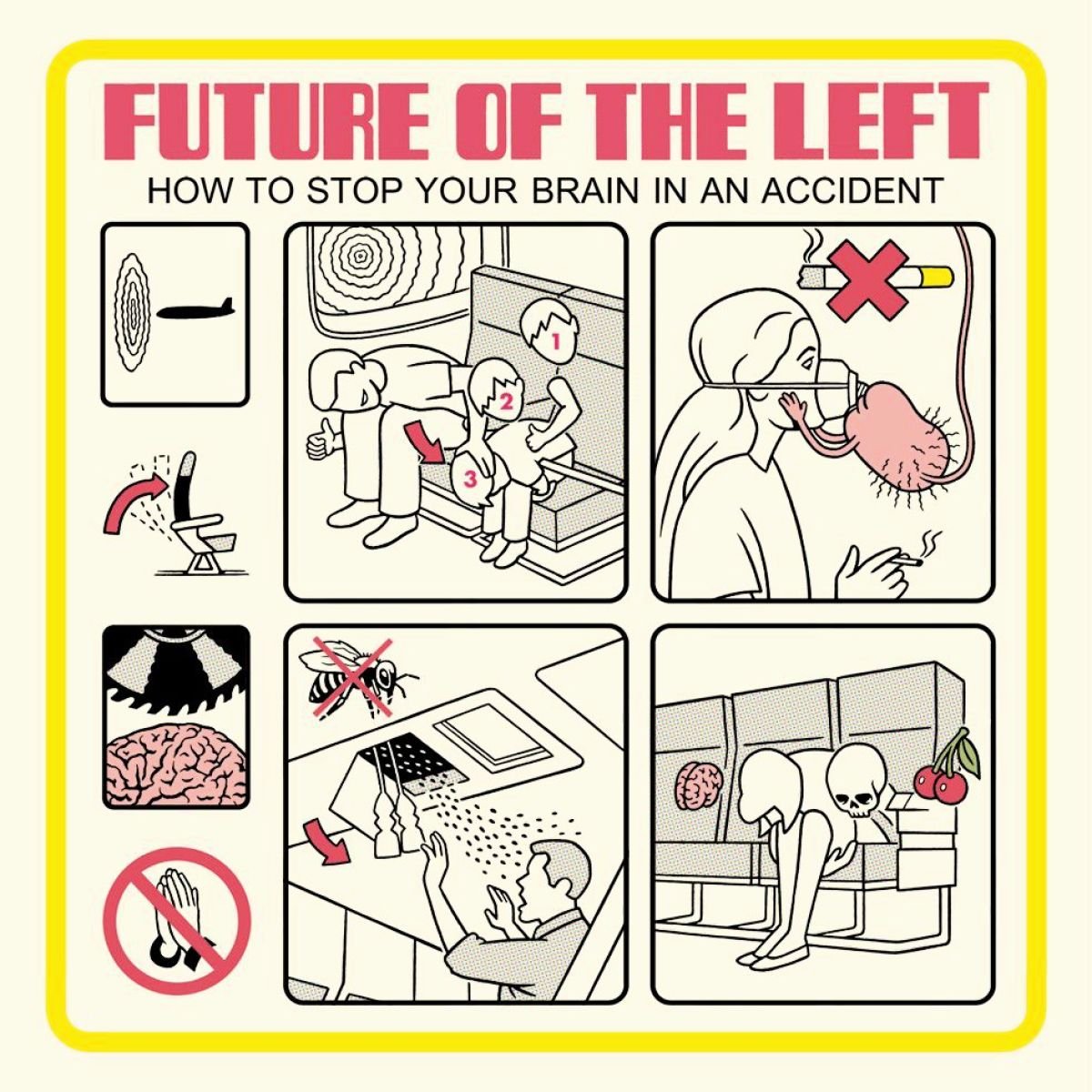
Future of the Left - How to Stop Your Brain in an Accident (*****)
“The music industry is lying to you” preaches Andy Falkous on
serrated satire Singing of the Bonesaws, chiding listeners for “[confusing] excitement
with the fear of missing out” before venturing down some dark recesses
involving Kim Kardashian, a masked bear and self-inflicted ocular mutilation.
It’s one of several tracks on Future of the Left’s fourth album to provoke nervy
laughs, with Falkous again proving a peerless lyricist: incisive, articulate and
pulling no punches as he eviscerates targets from Christmas to record labels.
On the latter note, the PledgeMusic-financed How to Stop Your Brain… is a paragon
example of crowd-funding done well: rawer, heavier and angrier than ever, it
distils the band’s abrasive appeal, and as such should leave no pledger
disappointed. Furthermore, tracks like French Lessons advance the quartet’s
less-frequently celebrated (but also rewarding) capacity for restraint, with Falkous’s
barbed sneer replaced with a precarious melodic croon (though with the opening
line “they say the price of love is a black hole”, its curbed aggression
shouldn’t be mistaken for softness). From the growling bass of Bread, Cheese,
Bow and Arrow to the unhinged howls of Why Aren’t I Going to Hell?, it’s quite
possibly their best work yet – so whatever Falkous says, don’t miss out.
Out 21st October
Sunday, 6 October 2013
film review: The Pervert's Guide to Ideology
A semi-sequel to The Pervert’s Guide to Cinema, The Pervert’s Guide to Ideology sees cult philosopher Slavoj Žižek lecture on the ideological constructs that have shaped history, and which continue to shape our dreams and day-to-day decisions. Director Sophie Fiennes repeats the aforementioned documentary’s style, keeping things visually as well as intellectually interesting with film extracts, archive footage and clips of Žižek pontificating in themed locales – the latter a still-amusing conceit that inserts the theorist into various texts just as ideology, he argues, inserts itself into us.
As he hops from Travis Bickle’s bunk to Leni Reifenstahl’s aeroplane to a booth in the Korova Milk Bar, his arguments stay accessibly salient despite a formidable vocabulary of interpolation and the like, largely thanks to an idiosyncratic intellect that draws examples from across the pop culture spectrum. Only Žižek could so convincingly transition from Cabaret to Rammstein, or flow from The Sound of Music to Kinder Surprise to Beethoven’s 9th, and while a mere 130 minutes can’t do justice to the reams of theory underpinning it, its nonetheless hugely engaging.
As he hops from Travis Bickle’s bunk to Leni Reifenstahl’s aeroplane to a booth in the Korova Milk Bar, his arguments stay accessibly salient despite a formidable vocabulary of interpolation and the like, largely thanks to an idiosyncratic intellect that draws examples from across the pop culture spectrum. Only Žižek could so convincingly transition from Cabaret to Rammstein, or flow from The Sound of Music to Kinder Surprise to Beethoven’s 9th, and while a mere 130 minutes can’t do justice to the reams of theory underpinning it, its nonetheless hugely engaging.
Out now
Friday, 4 October 2013
Field Music: An Interview with Jack Barnett of These New Puritans
Ahead of this month’s tour, we talk to These New
Puritans’ Jack Barnett about their visionary, Elton-praised third album
Field of Reeds
“This music’s symbolic,” sang Jack Barnett on These New Puritans’ debut Beat Pyramid. But while there were obscurities and tensions to sink into and unpick from the start, it wasn’t until 2010’s Hidden that the symbolism and complexities truly began to take hold. As taiko drums confronted children’s choirs, lyrics spun riddles of Egyptian gods, swords and labyrinths, making an open mockery of early, confused efforts to align the band with the transitory pleasures of nu-rave.
On tracks like We Want War, Barnett embarked on psychogeographic tours that evoked Sebald, Keiller and other chroniclers of the British landscape as much as any musical points of reference, resulting in an album of striking ambition – the sort of grand project that can see lesser acts flounder in a mire of self-importance, but which, for These New Puritans, evidenced a conceptual, compositional intelligence unafraid to challenge its listeners without severing all tethers to the mainstream.
“We don’t fit easily into certain brackets,” says Barnett, speaking over the phone in-between legs of an extensive tour that’s seen them collaborate with avant garde vocalist Salyu in Tokyo and support Björk in Los Angeles, and which this month takes them around the UK. “I like the fact that we do that, because we always have one foot in popular music, or with a popular music audience, whatever that might entail. I like that it’s not exclusive.”
This balance between experimentation and accessibility continues with recently released third album Field of Reeds [review here], which ditches the militant percussion and mantric vocals of its predecessor in favour of a quieter, more pastoral tone. While much has been made of the album’s more esoteric aspects – the arrangement of tracks into extended suites; the estuarine topography traversed by its lyrics – it’s not as opaque as the sum of its parts, which incidentally range from a prototype Magnetic Resonator Piano to a hawk taking flight (together, a neat representation of an album with its roots in nature and its sights future-facing).
"There are very few bands in the world who have the level of autonomy that we have" – Jack Barnett
To Barnett’s evident chagrin, the hawk recording has been a conspicuous focal point in recent interviews (“music doesn’t lend itself well to being talked about – there isn’t a good vocabulary for it really, so for that reason everyone has to talk about everything other than the music,” he sighs), but he volunteers background information for the other piece of kit, which uses electromagnets to warp the piano’s string vibrations into something straight out of the BBC’s Radiophonic Workshop. “Most of the time it’s obvious to me when I write a piece of music what instrument should carry a part or roughly what the sound should be,” he explains. “Because of the way we work, with lots of instruments, we can’t muck around in the studio – we kind of have to plan every hour precisely. But there was one sound on the album where I didn’t really know how we’d get it. We called it an ‘un-organ’ – a kind of organ sound, but something else. It was the last piece in the jigsaw. I thought I was going to have to sound design it, to fit this particular role, and then purely by chance we got a phone call from someone who had seen a demonstration of this instrument that had recently been invented. So yeah,” he deadpans, “that was a bit of luck.” It’s the first time the piano’s otherworldly timbre has featured on an album, but you don’t doubt for a minute that novelty played little part in its inclusion.
When even the piano sound comes with a layer of mystery, it’s clear why These New Puritans attract active, investigative listeners. With recurring motifs and repeated imagery, their music offers a rabbit hole down which to get lost, seemingly filled with immeasurable meanings that beg to be deciphered. “Our music does seem to invite a lot of peculiar interpretations,” Barnett agrees. “It reminds me: I recently got a letter from a molecular biologist who was saying that Hidden was all to do with Christian symbology. That was quite an interesting read.” Not only does the example indicate the intellectual calibre of the average piece of These New Puritans’ fan mail, it also makes clear the breadth of interpretive possibilities. “A lot of interpretations seem to say and write that it’s really ominous and dark music,” Barnett adds, “but for me, quite a lot of the songs are quite hopeful. There’re bits of darkness in them and bits of lightness.”
The other key narrative to have affixed itself to Field of Reeds is Barnett’s Kubrickian desire to get things absolutely perfect, Working Time Directive be damned. For Fragment Two, it reportedly took 76 takes for twin brother George to nail the drum sound the band had in mind. “The process of making this album necessitated inhabiting this very insular world,” Barnett reflects. “I think a lot of people got sick of us because we were determined to get it right at all costs. It’s quite a difficult mindset to get out of actually – I remember a couple of weeks after we’d finished the album I went to buy a pair of shoes. I don’t care about shoes, it’s not something I think about, but I ended up taking them back and getting more, then taking them back and getting more until they were exactly right. I think we had to be a bit rehabilitated.”
Barnett credits the process of rearranging songs for live performance with “bringing the pieces back to life” again after the precision engineering of the studio. “It’s a process I’ve enjoyed quite a lot for this album,” he says. “When you’ve been working on the music for a long time, getting it to its final state…” he pauses. “It sounds a bit like a bullshitty artist thing to say, but I’ve lived very close to this music and given so much for this album that it was difficult. I don’t like listening to things after I’ve finished them, because I think too much about what I would change. But when you’re reinventing the music live, you make it different every night and add different things. I think this band generally is probably the best we’ve had. We’ve a seven piece-band – small enough that we can have agility and big enough that we can bring a lot of different sounds. Plus we’ve got Elisa [Rodrigues, Portuguese jazz singer who appears on several Field of Reeds songs] singing with us, which is pretty fun because she can do her 50 per cent and I can do my 50 per cent. I don’t have to try and do everything – we can specialise a little bit.” And it’s not just vocal duties that are divided 50/50, with Barnett promising an equal split between Hidden and Field of Reeds material at the upcoming shows. “It gives us a big range of contrasts,” he somewhat understates. “It allows us to do a lot of stuff.”
This freedom to ‘do a lot of stuff’ is not one Barnett takes for granted, noting that “there are very few bands in the world who have the level of autonomy that we have.” Indeed, These New Puritans seem to occupy a blessed middle ground where they have the time and budget to, for instance, set-up 28 Thai gongs or spend a day recording the sound of smashing glass (both features on Field of Reeds), despite the decidedly un-commercial end results. Barnett has also recently become more involved in the band’s visuals, scripting a ten-minute animation for V (Island Song), due later this year. “Up to a point any idea is just as expensive and time-consuming as any other idea, they just have to draw it. So it’s amazing what you can do, in terms of the range of ideas you can use,” he enthuses.
We end by asking about a tweet (“not ‘industry’ enough”) made the night of the recent Mercury Music Prize shortlist announcement, for which Field of Reeds was submitted for consideration but not chosen. “People had said to me ‘oh no, that’s so disappointing,’” Barnett explains, “but I never expected to get it. I just don’t think it’s the kind of album that would go on,” before noting that he’s “not deadly serious all the time” and drawing attention to the tweet that followed in order to prove it (“Maybe it’s the fact that we’re touring with the Operation Yewtree Roadshow as support act”).
When asked more generally if there are any accolades that mean something to him, Barnett's pensive interview manner suddenly becomes animated. “Yeah, yeah!” he replies. “In today’s Guardian, Elton John said he loves the arrangements on Field of Reeds. I genuinely think he’s an incredible songwriter, so that’s fantastic.” But, he adds, the most satisfying feedback comes from less starry quarters. “It’s more important to me when people come up to me and say things like ‘this album changed the way I think about music,’” he concludes. “That’s a wonderful thing to hear.”
Thursday, 3 October 2013
live review: Manic Street Preachers, Public Service Broadcasting @ Barrowlands, 29th September
With prop televisions screening cut-and-paste newsreel and a sound that marries krautrock jams with clipped RP samples, Public Service Broadcasting’s
high-concept, wartime arts-and-Krafts-werk schtick sees this evening
off to a spiffing start. Clipped talk of planes, trains and automobiles
is reflected in the dynamic momentum of tracks like Signal 30
(invigoratingly noisy), Theme from PSB (more playful, with banjo
augmenting the various electronics) and other picks from their
archive-raiding debut – the title of which (Inform – Educate – Entertain) could stand as a manifesto for tonight’s headliners.
Indeed, James Dean Bradfield makes it clear that information and education still spur Manic Street Preachers 21 years after their debut’s righteous, erudite bravado. “I wish a younger band would try and write a lyric like this,” he bristles, “the lazy fucking gap year bastards…”, introducing a song (30-Year War) that references the Battle of Orgreave, L.S. Lowry and “the endless parade of old Etonian scum [that] line the front benches” – proof that while Rewind the Film may be their acoustic album, it hasn’t quietened their political ire.
Said album furnishes their set with another five tracks, from single Show Me the Wonder (dedicated to tonight’s crowd for making “a Sunday feel like a Saturday”) to the folky feel of This Sullen Welsh Heart. The latter forms part of Bradfield’s customary mid-set solo section, which culminates in The Everlasting – sung back in full, dodgy pronunciation and all. With their other millennial hits also accounted for (Tsunami, You Stole the Sun, If You Tolerate This), this alternation between unplugged and commercial-peak anthems risks overlooking other (often more interesting) corners of their discography, with whole albums unrepresented and others given only cursory visitations.
But if the song choices seem uninspired it’s only in comparison to past visits – and in terms of execution, there’s little to criticise. Furthermore, although loaded with songs from the softer end of their output, they keep their big guns close at hand: the iconic riff of Motorcycle Emptiness opens proceedings to ballistic effect; sole Holy Bible-offering Revol forms a fitting Richey-tribute; while Motown Junk sounds as fiery and fresh as ever. But some of the loudest cheers of the night come from “fuck-up of fashion” Nicky Wire’s announcement that they’ve already got the Barrowlands booked for April next year, coinciding with ready-to-go 12th album Futurology. Judging by the high-emotion of finale Design for Life, there’ll be more than a few here choosing to repeat the experience.
Indeed, James Dean Bradfield makes it clear that information and education still spur Manic Street Preachers 21 years after their debut’s righteous, erudite bravado. “I wish a younger band would try and write a lyric like this,” he bristles, “the lazy fucking gap year bastards…”, introducing a song (30-Year War) that references the Battle of Orgreave, L.S. Lowry and “the endless parade of old Etonian scum [that] line the front benches” – proof that while Rewind the Film may be their acoustic album, it hasn’t quietened their political ire.
Said album furnishes their set with another five tracks, from single Show Me the Wonder (dedicated to tonight’s crowd for making “a Sunday feel like a Saturday”) to the folky feel of This Sullen Welsh Heart. The latter forms part of Bradfield’s customary mid-set solo section, which culminates in The Everlasting – sung back in full, dodgy pronunciation and all. With their other millennial hits also accounted for (Tsunami, You Stole the Sun, If You Tolerate This), this alternation between unplugged and commercial-peak anthems risks overlooking other (often more interesting) corners of their discography, with whole albums unrepresented and others given only cursory visitations.
But if the song choices seem uninspired it’s only in comparison to past visits – and in terms of execution, there’s little to criticise. Furthermore, although loaded with songs from the softer end of their output, they keep their big guns close at hand: the iconic riff of Motorcycle Emptiness opens proceedings to ballistic effect; sole Holy Bible-offering Revol forms a fitting Richey-tribute; while Motown Junk sounds as fiery and fresh as ever. But some of the loudest cheers of the night come from “fuck-up of fashion” Nicky Wire’s announcement that they’ve already got the Barrowlands booked for April next year, coinciding with ready-to-go 12th album Futurology. Judging by the high-emotion of finale Design for Life, there’ll be more than a few here choosing to repeat the experience.
Wednesday, 2 October 2013
reviews: The Pure Conjecture, Young Aviators, Your Loyal Subjects

The Pure Conjecture - Gendres (****)
With its electric pink colour scheme and handwritten font,
one would be forgiven for approaching Gendres
with thoughts of Kavinsky and satin scorpion jackets in mind. If so, you’d be
advised to quash such wayward associations, for The Pure Conjecture offer retro
pleasures of a very different fashion. This is sophisticated, soulful night
music in which lush production and bandleader Matt Eaton’s measured croon evoke
everyone from The Zombies to Curtis Mayfield to Teenage Fanclub.
As on debut Courgettes,
Eaton’s backed by a raft of musicians including fellow Armellodie artist Johnny
Lamb (Thirty Pounds of Bone), plus members of British Sea Power, Electric Soft
Parade and The Hazey Janes. Together, this super-ish-group provide a rich array
of instrumentation, with cinematic strings, warm brass and some gorgeous
glockenspiel lines all bubbling up at different junctures. Thankfully, any potential
for a broth-spoiling surfeit of cooks is nimbly avoided, with subtlety reigning
throughout and all elements balanced beautifully.
Out 7th October

Young Aviators - Self Help (***)
Born in Northern Ireland but embraced by their adopted home
of Glasgow to the tune of a place on the Electric Honey roster, Young Aviators offer
strong introductions on debut Self Help.
Stow College’s student-run label has a decent ear for commercial prospects, and
though stylistic similarities are slight, you wouldn’t discount Young Aviators
following past signees (and fellow Irish émigrés) Snow Patrol into the big
leagues, with their catchy choruses built to fit larger venues than those they
currently inhabit.
While their default position is upbeat and bouncy, a couple
of more sedate numbers (namely apocalyptic ballad Deathrays in Disneyland and
AOR finale Sunset on the Motorway) introduce pleasant contrasts; there’s enough
lyrical finesse, meanwhile, to add depth to the evident surface pleasures.
Running to just nine tracks (including a semi-reprise) it remains to be seen
whether Young Aviators have the legs for the long-haul, but for now they’re
flying.
Out 7th October

Your Loyal Subjects - Austerity Measures (***)
Led by guitarist and vocalist Doug MacDonald, one-time
duo Your Loyal Subjects return 50% larger, using an additional six-string to
open out their sound. Their interest in dynamic riffage remains (as does their
eye for a striking sleeve design) but otherwise second full-length Austerity Measures evidences
a diffusion in MacDonald’s musical interests, offering considerable variety
across its 10 tracks.
Arguably, the band’s principal selling points are
technical, with MacDonald and cohort Benn Smith equally comfortable whether
tackling crisp afro-beat grooves or crunchy metal-tipped fretwork. Behind the
kit, meanwhile, Kirsty MacConnell proves similarly versatile, her restless
rhythms enlivening standouts like Hypersleep. Less distinguished are
MacDonald’s vocals (more than passable in a live context but blighted by
limited range on record), while errant quality control means it’s not only
genre that varies from one track to the next. Consequently, while Austerity Measures is frequently exhilarating, it ultimately falls
short of the heights it hints at.
Out 7th October
Tuesday, 1 October 2013
GFT programme note: Hannah Arendt

Great minds don’t always make great cinematic subjects. Not only do the time pressures of the form – which by convention must get from setup to conclusion in a reasonably brief period – somewhat preclude the kind of complexity inherent in any suitably developed philosophy or theory; but, equally importantly, the internality of thought is not a natural fit for a visual, narrative-driven medium. This is the conundrum at the heart of Margarethe von Trotta’s biopic of German-American political theorist Hannah Arendt (played by von Trotta regular Barbara Sukowa). While still in post-production, von Trotta summarised the issue in interview. ‘How does one use film to describe a woman who thinks?’ the co-writer and director asked. ‘That is of course the big challenge when making a film about intellectual personalities.’[1]
From the finished film, it seems part of the solution was to narrow the focus; to resist the urge to survey a life in its totality and select with care only the most pertinent slice. ‘We considered starting with Arendt entering Heidegger’s seminar in Marburg [in 1924] and going up to her death [in 1975], but we realised it wouldn’t work,’ von Trotta explains, ‘because to make a film about a philosopher you have to deal with her capacity to think, not simply jump from one event in her life to another.’[2] So while the script includes flashbacks to key moments in the early development of Arendt’s political thought, the plot is otherwise restricted to just a few years in the early sixties, when her reportage of the trial of Nazi war criminal Adolf Eichmann – initially for The New Yorker and later collected and published as Eichmann in Jerusalem – ignited a fierce controversy on two fronts: first, in response to her accusations of complicity on the part of Jewish leaders; and second, surrounding the term ‘the banality of evil’ – a phrase inspired by her impression of Eichmann as emphatically ‘ordinary’ despite the immensity of his crimes, which has since acquired a kind of banality of its own through regular re-application to events from the Rwandan genocide to Abu Ghraib. The first charge drew angry denouncements labelling Arendt a self-hating Jew, while the latter was interpreted in some quarters as either a trivialisation of the suffering in which Eichmann was intricately involved, or an attempt to defend the un-defendable by diminishing his personal responsibility. Standing against such acrimony were those who saw in Arendt’s writing a then-radical prospect: that evil is not only the preserve of the diabolical, but the mediocre; that a failure to think could facilitate unthinkable deeds. ‘Nearly every major literary and philosophical figure in New York chose sides’ writes Roger Berkowitz in a recent opinion piece for The New York Times,[3] going on to reference Irving Howe’s 1982 caution that ‘such controversies are never settled. They die down, simmer, and erupt again.’[4]
Indeed, the debate’s sediment has recently been stirred – not only by Hannah Arendt, but by another film to premiere in recent months. Based on interviews made around the time of his landmark documentary Shoah (1985), The Last of the Unjust is, according to reports from Cannes, director Claude Lanzmann’s repudiation of accusations of Jewish collaboration. It consists of lengthy discussions with former Jewish Council President Ben Murmelstein, who presided over the day-to-day workings of Theresienstadt concentration camp and reported directly to Eichmann. To Lanzmann’s mind, Murmelstein was anything but a weak or deplorable participant in the annihilation of his own people, but rather someone ‘crushed by a hellish system… the victim of savage contradictions’;[5] Eichmann, meanwhile, ‘was no mere bureaucrat!’[6] Though the interview transcripts have been available for many years, the documentary’s near-contemporaneous arrival with Hannah Arendt has, for some, made the latter look insufficiently critical of its subject’s less successful arguments.
There is perhaps a ring of truth to charges of hagiography. Throughout the film, any sympathetic supporting characters (including novelist/confidante Mary McCarthy and poet/husband Heinrich Blücher) are afforded sensitive portrayals, but outspoken critics like Norman Podheretz (who famously penned a riposte subtitled ‘A study in the perversity of brilliance’) are reduced to broad caricatures, even robbed of a surname in the credits. This not only confirms on which side of the fence von Trotta stands; it arguably manhandles the audience into sharing it, rather than allowing them the space and balance to draw their own conclusions.
The exception is its representation of fellow philosopher Hans Jonas (Ulrich Noethen) – a close friend of Arendt shown to bitterly reject her arguments. He is the film’s most developed voice of opposition, and though his screen time is slight, the placement of his scenes emphasises their impact. For instance, while focussing on this single episode in Arendt’s life sees the film venture close to one of the biopic genre’s most overused clichés (namely a narrative arc in which a forward-thinking subject produces their seminal work in the face of opposition), the semi-victorious finale in which Arendt passionately defends her work before students and peers is emotionally undercut by the scene immediately after, in which Jonas expresses his continued hurt and anger. Jonas, not Arendt has the final word, revealing a greater dialecticism than the film’s most emphatic detractors have recognised. Indeed, the fact that this climax effectively consists of a lecture-hall question-and-answer session evidences von Trotta’s express efforts to not only depict concrete actions, but to expound as much as possible on abstract ideas; ‘to describe a woman who thinks’ by presenting not only the woman, but the thoughts.
Christopher BuckleFreelance researcher and journalist
September 2013
[1] Thilo Wydra (2012), ‘Margarethe von Trotta on Hannah Arendt: ‘Turning thoughts into images’’, Goethe Institut, accessed 23/09/13 at http://www.goethe.de/kue/flm/far/en8898031.htm
[2] Graham Fuller (2013), ‘Q&A: Margarethe von Trotta on Filming Hannah Arendt’s Public Ordeal’, Blouin Artinfo, accessed 23/09/13 at http://www.blouinartinfo.com/news/story/909147/qa-margarethe-von-trotta-on-filming-hannah-arendts-public
[3] Roger Berkowitz (2013), ‘Misreading ‘Eichmann in Jerusalem’’ The New York Times, accessed 23/09/13 at http://opinionator.blogs.nytimes.com/2013/07/07/misreading-hannah-arendts-eichmann-in-jerusalem/?_r=0
[4] Irving Howe (1982), A Margin of Hope, extract accessed 23/09/13 at http://www.dissentmagazine.org/online_articles/banality-and-brilliance-irving-howe-on-hannah-arendt
[5] Agnes Poirier (2013) ‘Claude Lanzmann returns to the Holocaust’, The Guardian, accessed 23/09/13 at http://www.theguardian.com/film/2013/may/14/claude-lanzmann-last-unjust
[6] Joan Dupont (2013) ‘Claude Lanzmann’s Postscript to ‘Shoah’’, The New York Times, accessed 24/09/13 at http://www.nytimes.com/2013/05/18/arts/18iht-dupont18.html
Out now on selected release
Subscribe to:
Posts (Atom)